
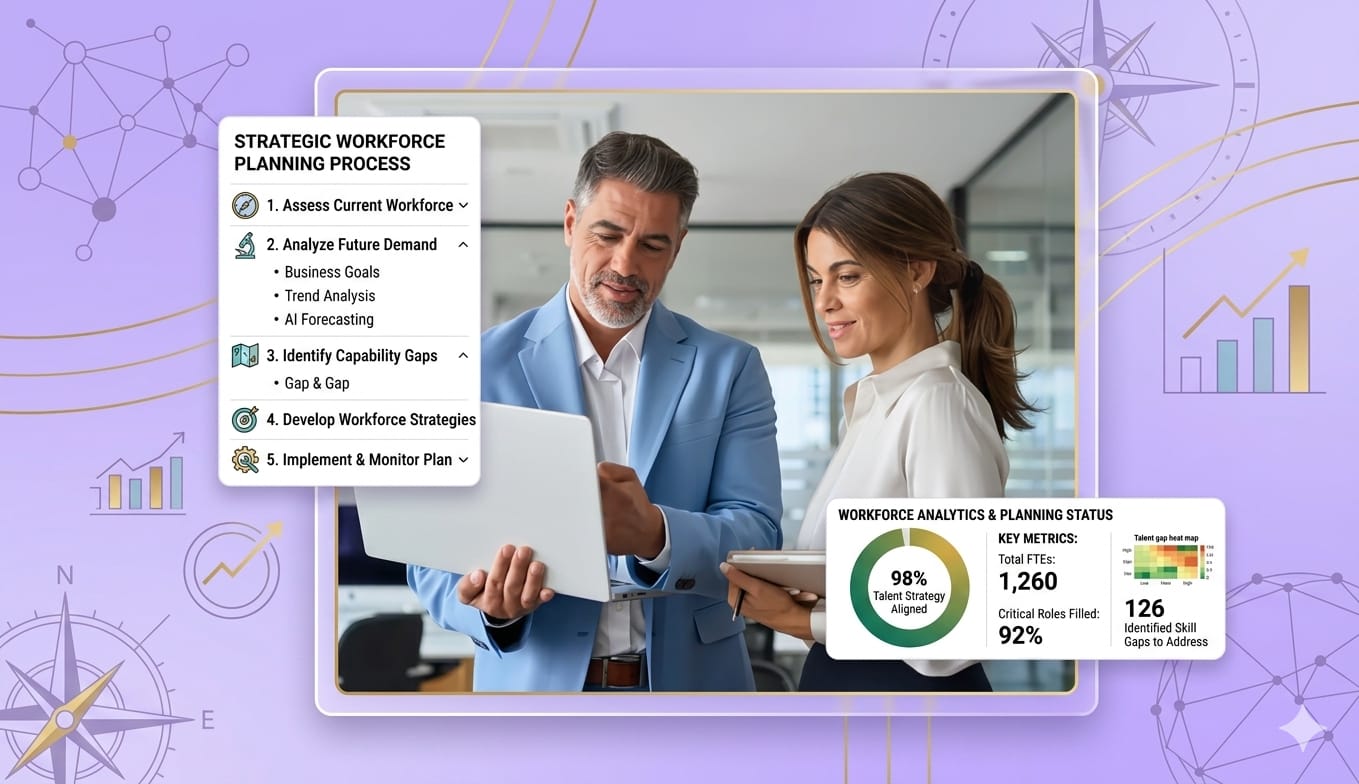
Strategic Workforce Planning (SWP) has expanded from a simple HR exercise into a core business strategy function. In 2026, organizations are no longer planning just for headcount—they are planning for skills, agility, and future disruption.
Companies that fail in workforce planning face talent shortages, rising costs, and missed growth opportunities, while those that succeed gain a competitive advantage through people.
Strategic workforce planning is a continuous process of aligning workforce capabilities with long-term business goals by analyzing current talent, forecasting future needs, and closing gaps proactively.
It helps organizations:
It works through two closely connected aspects.
The first is the “soft” side, which focuses on strategy and direction. Here, organizations interpret business goals, anticipate changes, and stay flexible in how they plan their workforce. It’s about seeing the bigger picture—understanding where the business is heading and what kind of people, skills, and capabilities will be needed to get there.
The second is the “hard” side, which focuses on data and analysis. This involves looking at workforce numbers, trends, and patterns to predict future needs. It ensures that planning is not just based on assumptions, but backed by real evidence and accurate forecasting.
Strategic workforce planning is far more than an HR exercise—it’s a core business capability that underpins long-term growth and resilience. Organizations without a clear workforce strategy often find themselves reacting to problems instead of preventing them, facing skill gaps, unexpected turnover, and inefficient talent investments.
Important Note
Businesses now plan 3–5 years ahead, not just for hiring—but for capabilities and transformation
A strategic workforce planning (SWP) framework is a structured yet flexible approach that helps organizations prepare their workforce for the future—not just respond to today’s needs. It connects long-term business goals with workforce capability, ensuring the organization is ready for change, growth, and disruption.
At its core, the framework is about building a workforce that is capable, agile, and aligned with strategy—so the right people, with the right skills, are in the right roles at the right time.
Instead of being a one-time exercise, SWP follows a continuous and cyclical process that evolves with business priorities and external trends like technology, demographics, and market shifts.
Start by understanding where the organization is heading. Workforce priorities are directly linked to business strategy, ensuring every talent decision supports long-term goals.
Analyze the current workforce and compare it with future needs. This includes assessing skills, capacity, and potential gaps based on emerging trends and scenarios.
Pinpoint workforce gaps and define solutions—whether through hiring, reskilling, restructuring, or new ways of working.
Turn plans into action. Deploy workforce strategies, manage risks, and ensure initiatives are integrated across the organization.
Continuously monitor outcomes, measure impact, and refine strategies to stay aligned with changing business needs.
In a rapidly changing world, organizations face constant pressure from technology shifts, evolving customer expectations, and workforce dynamics. A strong SWP framework helps organizations stay ahead by making workforce planning proactive, data-driven, and future-focused—not reactive.
Strategic workforce planning in 2026 is no longer a manual or intuition-based process. Organizations now rely heavily on data, analytics, and AI-driven platforms to align workforce capabilities with long-term business goals. The right combination of tools enables HR leaders to identify skill gaps, forecast future needs, and optimize talent investments with precision.
Workforce planning maps are visual frameworks that connect business strategy with workforce requirements. They help organizations clearly understand how current roles, skills, and structures align with future strategic objectives. By mapping out workforce supply versus demand, HR leaders can pinpoint gaps, redundancies, and critical roles that need attention. This tool is especially valuable when organizations are undergoing transformation, expansion, or digitalization.
In practice, workforce planning maps are created using tools like Microsoft Visio, Lucidchart, and Miro, which allow HR teams to visually design workforce structures and future scenarios. Enterprise platforms such as SAP SuccessFactors Workforce Planning and Workday Adaptive Planning also provide built-in workforce mapping features, enabling real-time alignment between HR data and business strategy.
HR analytics dashboards provide real-time insights into workforce metrics such as headcount, attrition rates, productivity, and skills distribution. These dashboards transform raw HR data into actionable insights, helping decision-makers monitor trends and make informed workforce decisions. In 2026, dashboards are increasingly interactive and predictive, offering not just historical data but future projections.
Common tools used for HR analytics dashboards include Power BI, Tableau, and Google Looker Studio, which integrate with HR systems to visualize workforce data. Additionally, HR-specific platforms like Visier, SAP SuccessFactors Analytics, and Oracle HCM Cloud provide advanced workforce analytics with built-in KPIs and predictive capabilities tailored for HR professionals.
The 9-box grid is a talent management tool used to evaluate employees based on performance and potential. It helps organizations identify high-potential employees, future leaders, and individuals who may need development or performance improvement. This tool plays a critical role in succession planning and leadership pipeline development.
Organizations typically use HR systems like Workday Talent Management, SAP SuccessFactors Succession & Development, and Cornerstone OnDemand to implement 9-box grid evaluations digitally. These platforms allow managers to assess employees, track performance trends, and create development plans based on grid positioning, making talent reviews more structured and data-driven.
Scenario planning tools enable organizations to model different future workforce scenarios based on variables such as market changes, economic conditions, or business expansion. These tools help HR leaders prepare for uncertainty by evaluating multiple “what-if” situations and their impact on workforce needs.
Tools like Anaplan, Workday Adaptive Planning, and Oracle Workforce Planning are widely used for scenario modeling. They allow organizations to simulate workforce changes, forecast hiring needs, and assess financial implications. Spreadsheet-based tools like Microsoft Excel are still used but are increasingly replaced by advanced platforms offering real-time collaboration and AI-driven simulations.
Compensation analysis tools ensure that workforce costs align with organizational strategy while maintaining competitiveness in the talent market. These tools help HR teams analyze salary structures, pay equity, and compensation trends to attract and retain talent effectively.
Popular tools include Payscale, Mercer WIN, and Willis Towers Watson compensation software, which provide market benchmarking data. HR platforms like Workday Compensation and SAP SuccessFactors Compensation also offer integrated solutions for salary planning, pay equity analysis, and incentive management.
| Tool Name | Key Platforms |
|---|---|
| Workforce Planning Maps | Microsoft Visio, Lucidchart, Miro, SAP SuccessFactors Workforce Planning, Workday Adaptive Planning |
| HR Analytics Dashboards | Power BI, Tableau, Google Looker Studio, Visier, Oracle HCM Cloud |
| 9-Box Grid | Workday Talent Management, SAP SuccessFactors Succession & Development, Cornerstone OnDemand |
| Scenario Planning Tools | Anaplan, Workday Adaptive Planning, Oracle Workforce Planning, Microsoft Excel |
| Compensation Analysis Tools | Payscale, Mercer WIN, Willis Towers Watson, Workday Compensation, SAP SuccessFactors Compensation |
AI-powered tools have become the backbone of modern workforce planning, transforming how organizations anticipate, prepare, and act on talent needs. Unlike traditional tools that rely on historical data, AI systems use machine learning and real-time data to generate predictive and prescriptive insights. This allows HR leaders to move from reactive decision-making to proactive workforce strategy. In 2026, AI tools not only highlight trends but also recommend actions—such as hiring plans, reskilling initiatives, or workforce restructuring—based on business goals and market dynamics.
These tools are especially powerful because they integrate multiple data sources, including HR systems, labor market intelligence, employee performance data, and even external economic indicators. As a result, organizations can predict turnover risks, identify future skill shortages, and optimize workforce costs with a high level of accuracy. AI also enhances fairness and efficiency by reducing bias in talent decisions and automating repetitive HR processes.
In 2026, AI is not just supporting decision-making—it is actively guiding it. Tools like Eightfold AI and Gloat specialize in AI-driven talent intelligence, helping organizations match employees to opportunities, projects, and career paths based on skills rather than job titles. SkyHive (by Cornerstone) focuses on skills intelligence, providing real-time insights into emerging skills and workforce capabilities. Meanwhile, Visier Predictive Analytics and Oracle HCM Cloud AI offer predictive workforce analytics, enabling HR teams to forecast attrition, hiring needs, and workforce costs. Platforms like Workday AI and SAP SuccessFactors AI integrate AI directly into HR systems, offering automated recommendations for talent management, succession planning, and workforce optimization.
AI-powered workforce planning tools typically include the following capabilities:
| Tool Name | Key Platforms |
| AI Talent Forecasting | Eightfold AI, Gloat |
| Skills Intelligence Platforms | SkyHive (by Cornerstone) |
| Workforce Optimization Engines | Workday AI, SAP SuccessFactors AI |
| Internal Talent Marketplaces | Gloat, Eightfold AI |
In 2017, IBM faced a critical talent gap. As the industry shifted toward AI and Cloud, their workforce remained anchored in legacy hardware and maintenance. Instead of mass layoffs, IBM leveraged its own technology—Watson—to execute a massive internal pivot. The result was a “Skills-First” architecture that revolutionized human capital management and delivered billions in productivity gains.
Legacy Skills in a Digital Era
IBM moved away from static job descriptions to a dynamic, data-driven skill ecosystem. The goal was to identify, reskill, and deploy talent with surgical precision.
1. Watson Skills Inference: Mapping the Invisible
IBM deployed AI to scan internal data points, including resumes, project emails, and digital badges.
2. “Ask HR”: The Digital HR Agent
To free up human capital for strategic work, IBM automated the “boring stuff.”
IBM’s transformation did more than modernize the brand; it fundamentally changed the company’s bottom line.
The IBM transformation offers a blueprint for enterprise-scale change management. Here are the core pillars of their success:
The United Kingdom is facing a demographic crisis: an aging population requiring more care, paired with a massive labor deficit. To prevent a systemic collapse, the National Health Service (NHS) launched the Long-Term Workforce Plan. This strategy moves away from reactive “crisis hiring” toward a self-sustaining “talent factory” model, ensuring the healthcare system remains viable for the next generation.
The “Silver Tsunami” vs. Labor Shortfall
The NHS shifted its philosophy: if the talent doesn’t exist in the market, the organization must build the infrastructure to create it.
1. The Education Surge: Doubling Down on Capacity
The NHS is aggressively expanding the domestic training pipeline to record levels.
2. The “Earn-While-You-Learn” Model
To democratize healthcare careers, the NHS broke the traditional university barrier.
By shifting from “hiring” to “building,” the NHS is projecting radical improvements in sustainability and cost-control.
Expansion is often mistaken for simple distribution. For Netflix, moving into 190 countries required more than just a fast server; it required a total reimagining of corporate structure. By abandoning the “Hollywood-Centric” model in favor of Decentralized Hubs, Netflix transformed from a California tech firm into a local storyteller in every market it enters, resulting in a global subscriber base that now dwarfs its domestic audience.
The “Hollywood” Barrier
Netflix moved away from a “top-down” HQ. They built autonomous “Power Hubs” that live, breathe, and hire within the local culture.
1. Compliance & Cultural DNA
Rather than exporting American producers, Netflix empowers local creators to lead.
2. The Linguist Army: Translating Culture, Not Words
Literal translation often kills the “soul” of a script. Netflix built a specialized network to solve this.
By shifting from “hiring” to “building,” the NHS is projecting radical improvements in sustainability and cost-control.